 Gummy Mob
Color matching games for kids: types, ideas and how to play
From sorting socks to steering a crowd of gummy bears, here is how color matching games work and how to make them fun together.
In this guide
Color matching games ask a child to find things that share a color: sorting objects into groups, finding pairs, or picking the color that fits what comes next. Younger children enjoy slow games like sorting and pairs, while older kids often like fast games where the right color has to be chosen in a moment. Playing together and naming colors out loud keeps it fun.
Ask a small child to put all the red blocks in one pile and you have already played a color matching game. The idea is as old as toy boxes, and it shows up everywhere: in card games, in printables, in apps and even in action games for older kids.
This guide sorts color matching games for kids into a few simple types, shows you a home game you can set up in five minutes with things you already own, and explains how a faster color game works, using our own game Gummy Mob as the example. You do not need a screen for most of it.
What counts as a color matching game?
Any game where the main question is "which ones are the same color?" counts. The difference between games is mostly speed and how the match is shown.
- Sorting games. Put objects into groups by color: buttons into cups, blocks into boxes, socks into piles. There is no time limit and no wrong move that cannot be undone.
- Pairs and memory games. Cards lie face down, and you flip two at a time to find a matching pair. This adds remembering where things are.
- Spot and tap games. Find every yellow thing in a picture, or tap the balloon that matches the color shown at the top.
- Pick-the-color action games. Things move, and you choose a color in a moment so that it matches what is coming. These suit older kids who already know their colors well.
A good rule of thumb: the younger the child, the slower the game. A toddler who is still learning color names needs time to look, touch and talk. A school-age child may enjoy the rush of choosing quickly.
A no-screen color game you can set up at home
You do not need to buy anything for this one. It works well for little ones who are still learning the names of colors, and older siblings can join as "helpers".
- Pick four colors. Red, green, yellow and orange are a good start, because they are easy to tell apart.
- Make four bases. Use a sheet of colored paper, a cushion or a bowl for each color, and spread them around the room.
- Gather small objects. Toy cars, blocks, pegs, plastic cups or clean socks all work. Aim for a mix of the four colors.
- Play "bring me". Say "bring me something green" and let your child carry it to the green base. Swap roles so your child gives the orders too.
- Add a twist. Once it is easy, set a slow countdown, ask for two things at once ("one red, one yellow"), or hide objects around the room first.
- Finish with a count. Count how many things ended up on each base together. It makes a natural ending, and the tidy-up is already half done.
How fast color games work: the Gummy Mob example
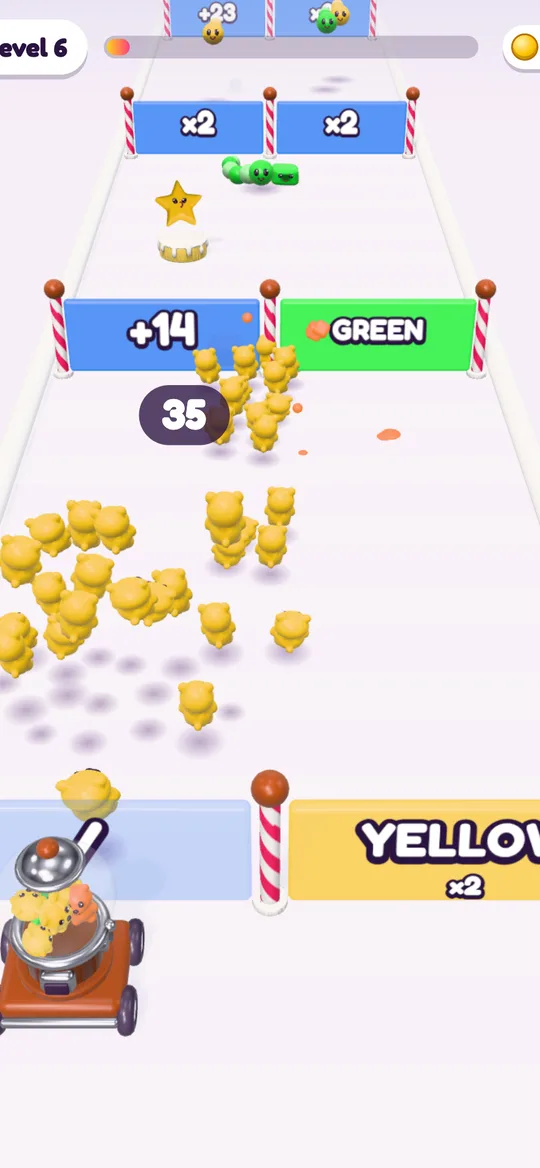
Some kids outgrow sorting and want something with more going on. Action games can use the same idea, just at speed. In Gummy Mob, a free crowd runner for Android, you fire a stream of gummy bears and steer it down a candy road. Along the way are pairs of gates. Some change the number of bears, and some are color gates that turn the whole crowd red, green, yellow or orange.
The matching rule is simple: a bear that matches the color of an enemy or a castle block hits 3 times harder. So the question every few seconds is "what color is coming next?"
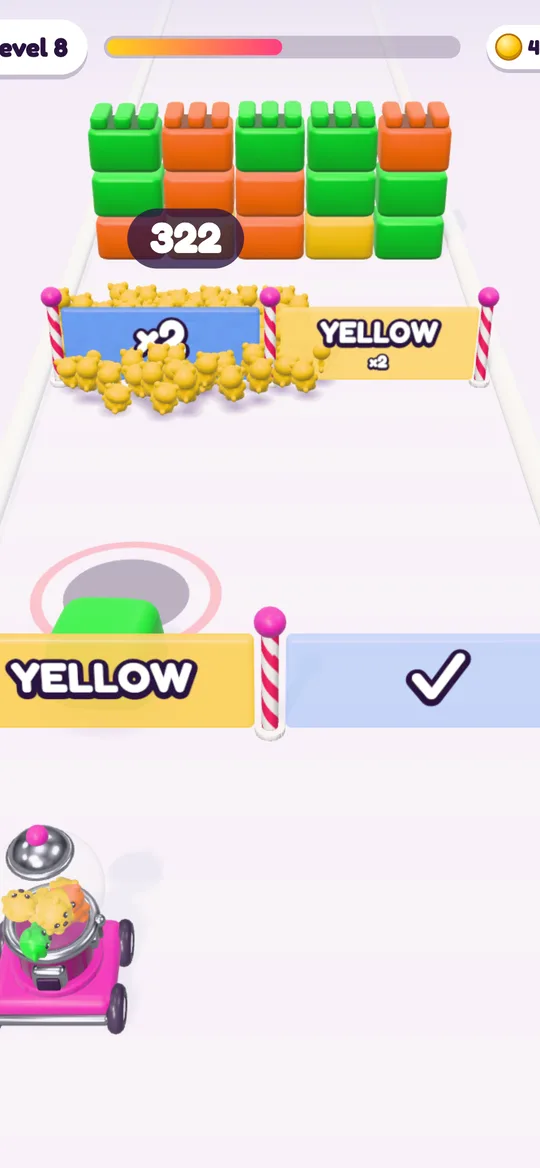
The game also eases children in. The first 5 levels use only 2 colors, levels 6 to 15 use 3, and from level 16 all 4 are in play. That slow build is a nice match for the "younger means slower" rule above. For the full tactics, read our color gates guide.
How to play a fast color game together
If your child wants to try an action game like this, playing side by side at first helps a lot. Here is a simple way to do it.
- Look before you play. At the start of a level, point at the castle and ask "which color is there the most of?" Agree on a color together.
- Call out the gates. As the bears run, name each gate out loud: "Green gate on the right, plus fourteen on the left."
- Let your child steer. Your job is to be the spotter. Theirs is to drag the stream into the gate you agreed on.
- Talk about the result. When the castle falls, ask what helped. Was it the right color, or more bears?
- Swap roles. Let your child be the spotter while you steer. Explaining a choice out loud is a fun challenge in itself.
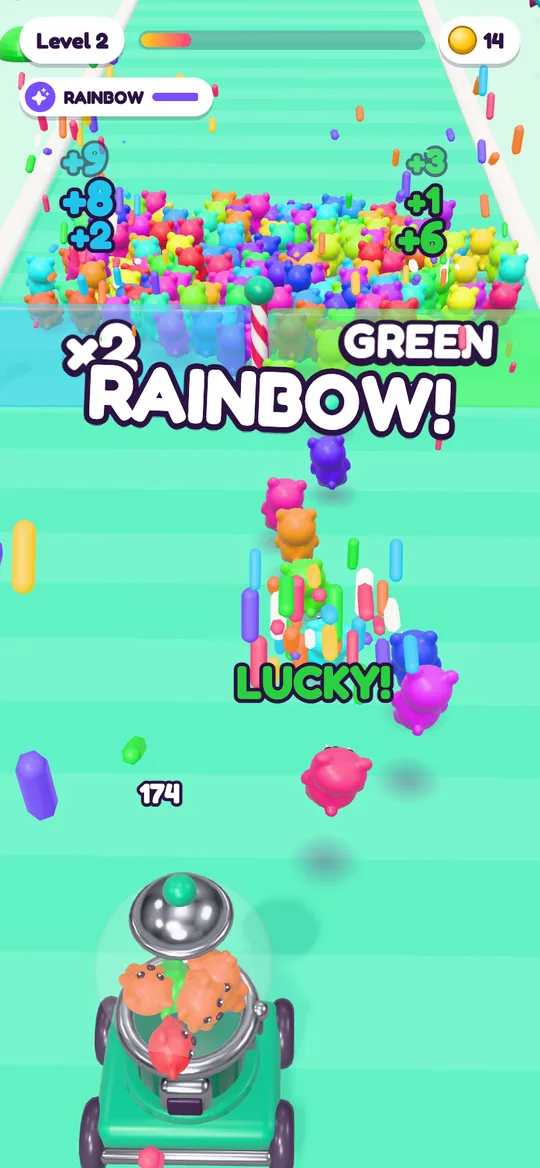
There are also power-ups that bend the rules for a moment. The rainbow power-up makes every color match for a few seconds, which tends to get a big cheer.
What to look for in a color game app
If you choose an app rather than a home game, a few checks are worth a minute of your time:
- Pace that fits the age. Toddlers do better with games that wait for them. Fast games suit kids who already know their colors.
- Clear colors. Big, bright, well-separated colors are easier to tell apart than many similar shades.
- How ads work. Free games often show ads. Look for games where videos only play when a button is tapped, and where ads never interrupt play.
- No chat and no account. A simple game does not need either.
- Offline play. Handy for car trips and waiting rooms.
As an example, Gummy Mob plays offline, has no chat and no accounts, and players under 13 only get child-directed, non-personalized ads. Our guide is Gummy Mob safe for kids explains the ad rules and the grown-up question in detail. If your child likes the gates and wants to grow a bigger crowd, our crowd runner tips are a good next read.
Ideas to keep color games fresh
Once a game becomes easy, small changes make it new again:
- Change the colors. Swap one color for a new one, such as purple or pink, so there is a new name to find.
- Go outside. Hunt for things of one color on a walk: a yellow door, a red car, a green leaf.
- Mix in counting. "Find three orange things" combines two games in one.
- Make it a story. The red team needs help getting home. Can your child build a path of red blocks?
- Turn the tables. Let your child set the challenge and check your answers. Kids love catching a grown-up making a mistake.
FAQ
What age are color matching games for?
Simple sorting and pairs games suit toddlers and preschoolers, who enjoy taking their time. Fast games where you choose a color in a moment suit older children who already know their colors well.
What is the easiest color matching game to start with?
Sorting is the easiest. Give your child a few objects in two or three colors and some matching cups or paper sheets, and let them put each object where it belongs. There is no time limit and no losing.
Do I need an app for color matching games?
No. Socks, blocks, toy cars and colored paper are enough for many games. Apps can add variety and speed, but most color matching play works fine without a screen.
How do color gates work in Gummy Mob?
A color gate turns your whole crowd of gummy bears red, green, yellow or orange. Bears that match the color of an enemy or a castle block hit 3 times harder, so the trick is picking the color of what is ahead.
Is Gummy Mob free?
Yes. Gummy Mob is free to play and has no in-app purchases. It shows ads, and reward videos only play when you tap a button to watch one. It is coming soon to Google Play for Android.