 Gummy Mob
How difficulty curves work in casual games: climb, spike, breather
Casual games are not just slowly getting harder. Most of them move in waves. Here is the shape, why designers use it, and how to play along with it.
In this guide
A difficulty curve is the way a game's challenge changes from level to level. In most casual games it is not a straight line up. It rises slowly, jumps at a planned spike such as a hard or boss level, then drops for a breather level before climbing again. Your own power grows too, through upgrades and new skills, so the game feels fair as long as the two stay close.
You clear five levels in a row, then one level stops you three times. A level later, everything is easy again. That is rarely luck. It is the game's difficulty curve doing its job, and once you can see the shape, you can plan for it.
This guide explains how difficulty curves in casual games are usually built, using the real rules behind Gummy Mob as a worked example. The ideas apply to puzzle games, runners and most level-based mobile games.
What a difficulty curve is
Picture a line chart. Across the bottom are the levels. Up the side is how much the game asks of you. That line is the difficulty curve.
A game could make the line a straight ramp, with every level a little harder than the last. Few casual games do that, for two reasons:
- A steady ramp feels flat. If every level is a tiny step harder, no single level feels like a moment worth remembering.
- A steady ramp never lets you breathe. You never get the level where you feel strong and get to enjoy what you have built.
So designers shape the line into waves. Each wave has a climb, a peak and a dip. The whole wave then sits a little higher than the one before.
The three parts of a wave
Most casual games, crowd runners included, build every wave from the same three parts.
- The climb. A few normal levels, each one slightly tougher than the last. New ideas usually arrive here, one at a time, so you learn them while the pressure is still low.
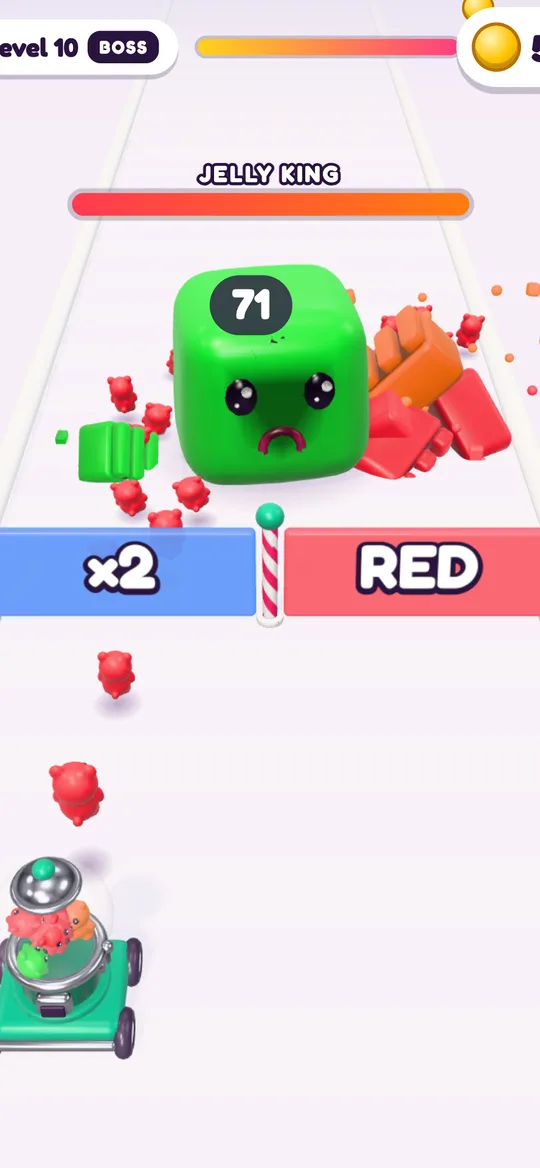
- The spike. A level that asks clearly more of you. It might be labelled HARD, or it might have a boss. It usually pays a bigger reward, so the extra effort feels worth it.
- The breather. Right after the spike comes a gentler level. You have just won something tough, and the game lets you feel it.
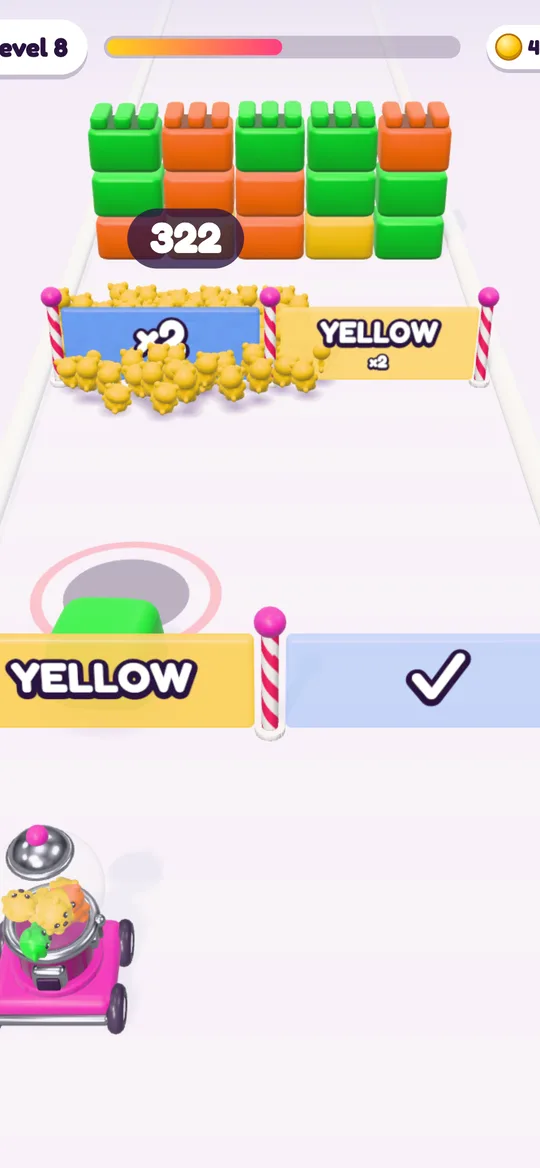
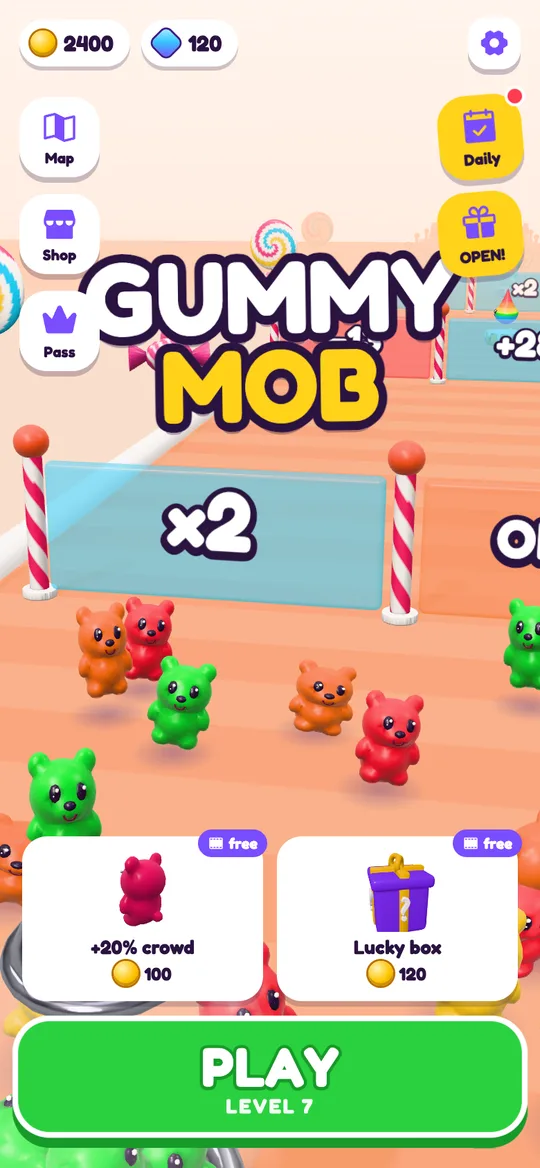
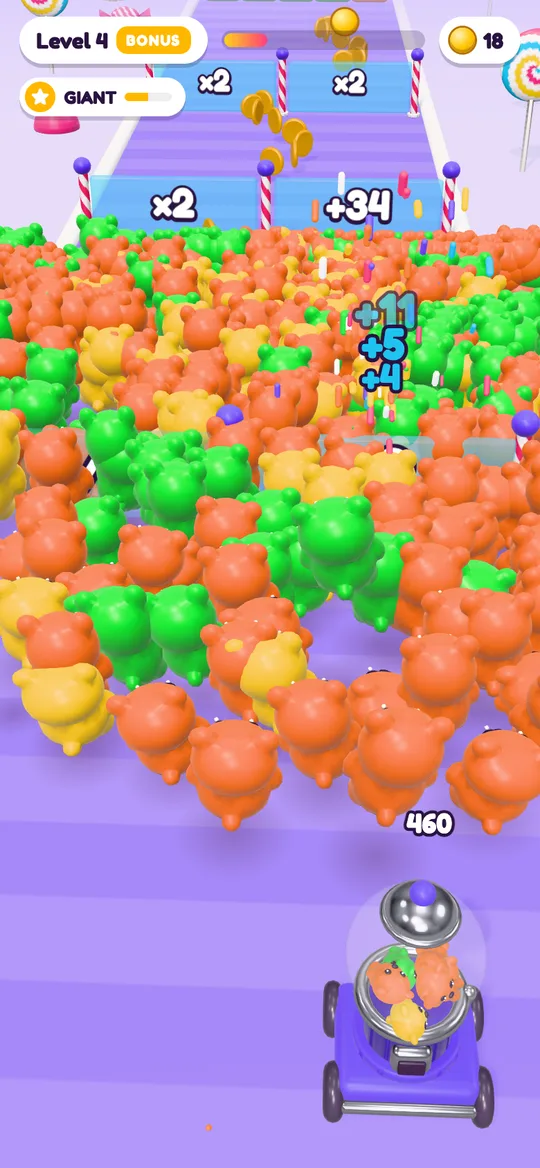
Gummy Mob repeats this pattern in blocks of ten. Levels that end in 5 are HARD levels, levels that end in 0 are BOSS levels, and the level after each boss is a BONUS level with gummy rain and no enemies at all. Inside the game's own code, the level after a hard level and the bonus level after a boss are the softest levels of each block, while the levels just before a spike climb towards it. If you want the details of the red badge, our guide to Gummy Mob hard levels covers them.
Two curves, not one
Here is the part many players miss. There is a second line on the chart: your own strength.
In a level-based game you get stronger as you play. You learn the rules, and you usually buy upgrades too. In Gummy Mob you spend the coins you win on start crowd, fire rate and bear power. The enemies grow from level to level as well, and the game is tuned so they grow a little faster than a typical player's upgrades. That small gap is what keeps later levels interesting.
The skill that closes the gap is colour matching. A bear that matches the colour of an enemy or a castle block hits 3 times harder. The number of colours grows in steps: 2 colours up to level 5, 3 colours from level 6 and all 4 from level 16. Each time a colour is added, the game softens enemy strength a little, because a one-colour crowd now matches less of what it meets.
So a level feels fair when the two lines stay close. It feels too hard when the challenge line jumps far above yours, and boring when it sinks far below.
How games keep a curve fair
Good curves are not just numbers. A few habits show up again and again in well-made casual games.
- One new thing at a time. In Gummy Mob's first twenty levels, most levels bring one new idea with a NEW! card: pickups at level 2, mystery boxes at 3, gummy worms at 4, flip gates at 7, jelly blobs thrown by the castle at 8, the Jelly King at 10 and so on. You never learn two tricks in the same run.
- A gentle start. The first four levels sit below the normal curve, so new players win early and learn the controls without pressure.
- Warnings before spikes. The HARD badge on the PLAY button and on the Candy Road map tells you a spike is coming before you start it.
- Quiet help after a bad run. Many games adjust a little behind the scenes. Gummy Mob eases off slightly after two losses in a row and tightens slightly after three wins in a row, within fixed limits, so a streak never flattens the whole curve.
- Small rewards for trying again. In Gummy Mob, Try again is always free, and the gates change their numbers on each try, so a second run is a fresh attempt rather than a copy.
How to play along with the curve
Once you know the shape, you can use it. These steps work in most level-based casual games.
- Check what is next. Look for a HARD or BOSS label on the map or the play button before you start.
- Spend before the spike, not after it. Upgrade on the level just before a hard or boss level, when the extra power matters most.
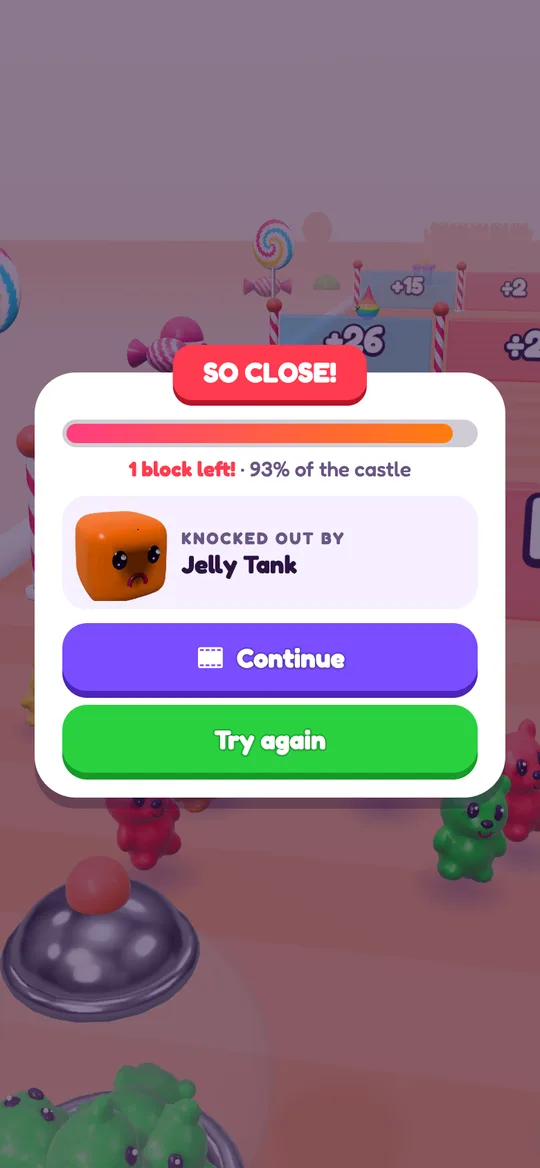
- Treat the spike as practice the first time. Watch what knocked you out. The loss card in most games tells you, and that tells you what to fix.
- Change one thing per retry. A different gate choice, a different colour, or one more upgrade. Changing everything at once hides what worked.
- Enjoy the breather. The level after a spike is your reward. It is a good place to rebuild a win streak or simply to stop for the day.
- Do not grind the breather. Replaying easy levels rarely helps much, because the challenge line is designed to stay a step ahead of where you are.
When a spike feels unfair
Sometimes a level really is a wall. That usually means one of three things.
- You skipped a skill. In a crowd runner, that is often colour matching. A crowd that matches the castle's colours knocks it down far faster than a bigger crowd that does not. Our colour gates guide shows how to read them.
- You are short on upgrades. If you lose halfway down the road, the early waves are the problem, and a bigger start crowd helps.
- It is a boss you have not met. Bosses add a new pattern on top of the usual rules. For the first boss in Gummy Mob, read how to beat the Jelly King.
If you are new to the genre, what is a crowd runner game explains how a single level fits together, and our guide to crowd runner games for short sessions shows how to use the breather levels as natural stopping points.
FAQ
What is a difficulty curve in a game?
It is the way a game's challenge changes from one level to the next. Drawn as a line, it shows where the game asks more of you and where it eases off.
Why do casual games have sudden hard levels?
A planned spike gives each stretch of levels a clear peak and a bigger reward. It breaks up a steady climb so wins feel earned, and it is usually followed by an easier level.
What is a breather level?
A breather is a gentler level placed right after a spike, such as the bonus level after a boss in Gummy Mob. It lets you enjoy the power you have built before the climb starts again.
Do games get easier if I keep losing?
Some do, a little. Gummy Mob eases off slightly after two losses in a row, within fixed limits. It never removes the challenge, so learning the level still matters most.
Is it better to upgrade or to practise on a hard level?
Usually both, in that order: upgrade on the level before the spike, then use your first try to learn the layout. Change one thing at a time on each retry.
How often are spikes in Gummy Mob?
Every fifth level is a spike. Levels ending in 5 are HARD levels, levels ending in 0 are boss levels, and a bonus level with no enemies follows each boss.